
Unlocking the Musical Strengths of Neurodiverse Learners: A Strengths-Based Approach
By Katalina Diller, MT-BC
Sometimes, it is easy to focus on what individuals are not able to do. I can only imagine what it feels like to be a parent and receive news that your child is neurodivergent. I can imagine a parent beginning to think about all of the things their child may not experience, or the struggles they may have throughout life. This is naturally part of being a parent: to worry about your child and want to protect them from the challenges they may face.
Unfortunately, this deficit-based thinking can also carry over into a traditional lesson environment. An instructor may become frustrated when a neurodivergent learner is not “keeping up” with their peers, or may not know how to teach them in a way that works for that individual child. Too often, teachers and instructors focus on the perceived deficits of a child and unintentionally put that student into a box based on what they believe the child is unable to do.
Looking for a neuro-affirming roadmap for your child’s musical journey? Download Our Free E-Book: “Finding Their Song: A Family’s Roadmap to Online Music Education for Neurodiverse Learners” to discover how we adapt lessons around your child’s unique gifts!
Shifting to a Strengths-Based Mindset
As a Board-Certified Music Therapist (MT-BC) at The Music Loft Academy (TMLA), one of the most important parts of my role is to celebrate the natural gifts of every child. One of my core philosophies is to enter every single session with a mindset rooted in strengths-based music instruction.
Instead of focusing on what a child is unable to do, I look at what they are able to do and find creative ways to build from there.
I feel that this philosophy not only leads to greater success within neurodivergent piano lessons, but it also makes the learning process infinitely more enjoyable for the child. When a child feels successful and understood, they are far more likely to want to participate, explore, and continue learning.
Think about a sport or activity you participated in as a child:
- Did you ever have a coach who never gave positive feedback and only pointed out what you were doing wrong? How did that make you feel?
- Do you think you would have responded differently if that coach had praised you for the hard work you were putting in and helped you find a position or role that best fit your strengths?
Music works in the exact same way.
Why Strengths Thrive in Online Music Lessons
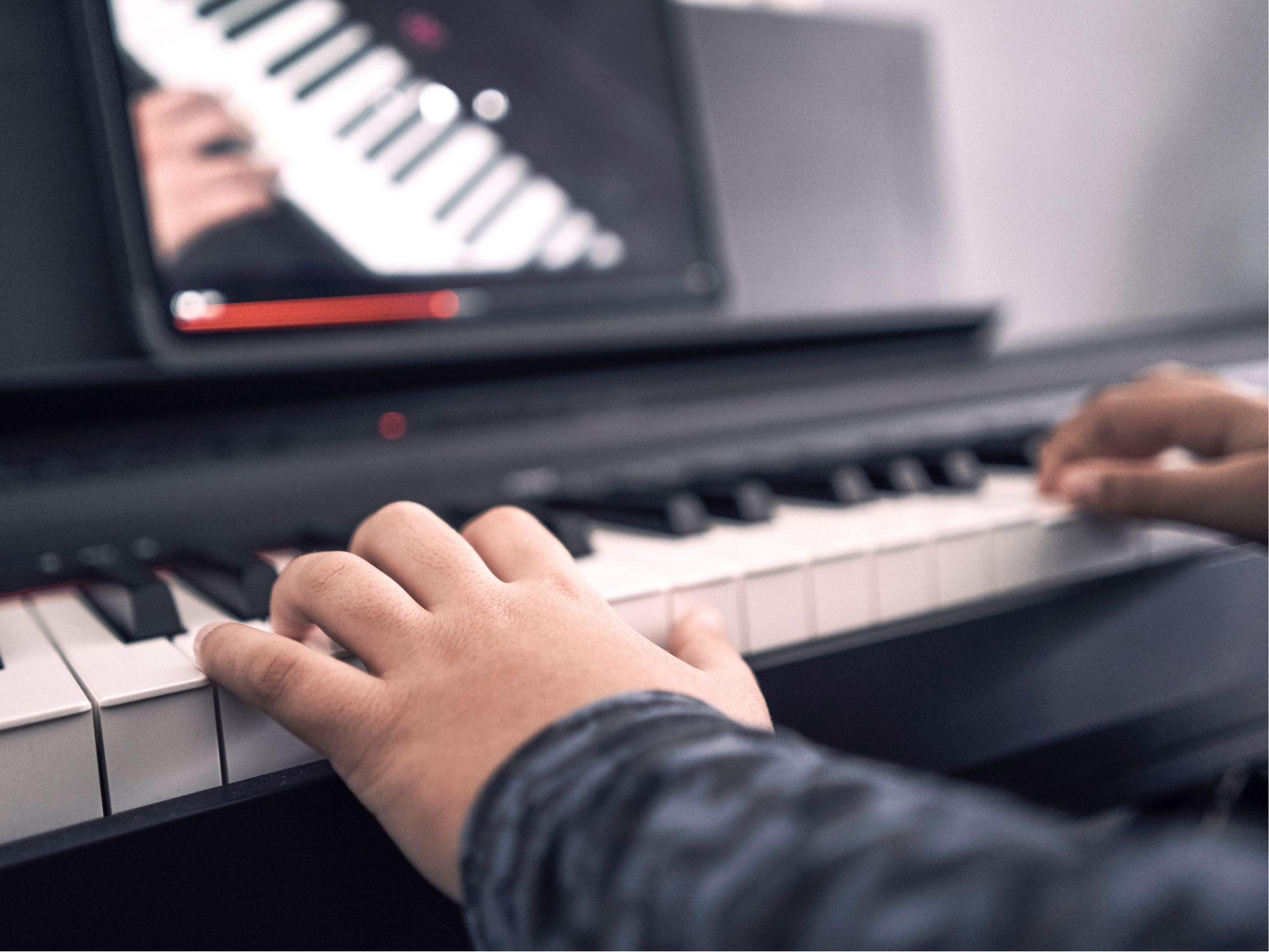
A strengths-based approach doesn’t lose its impact when music lessons move online. In fact, our setup for online piano lessons for autistic children can give teachers even more opportunities to notice and build on a student’s individual strengths due to the student being in their own comfortable environment.
Due to the nature of online lessons, the screen serves as a powerful form of adaptation where teachers can bring up visuals or interactive experiences to increase engagement.
- Real-Time Adaptation: The screen does not serve as a barrier; it becomes a space where lessons can be adapted in real time to the learner’s interests, communication style, and unique way of processing music.
- Following the Student’s Lead: Rather than asking every student to learn in the same way, the teacher can follow the student’s strengths and use them as a natural pathway into new musical skills
Empowering Parents as Co-Teachers at Home
Online lessons also give parents a valuable window into their child’s learning.
Because parents act as a co-teacher during live virtual sessions, they can see firsthand what motivates their child, which musical activities help them stay engaged, and how the teacher adapts instruction to their strengths. This can transform parents from observers into confident partners in their child’s musical development.
Due to the close interactions between parents and students during lessons, the parent gets to deepen their connection with their child through a positive, strength-based experience. Over time, these observations give families practical strategies they can carry into everyday musical experiences at home.
Discovering Neurodiverse Musical Strengths in Practice
Something I have seen firsthand when guiding students is that children on the autism spectrum often possess incredible musical gifts that may not always be immediately recognized in a traditional, rigid studio setting.
When a teacher recognizes these musical strengths in autistic children and knows how to play into them, they become a powerful engine for learning:
- Incredible Pitch Recognition: Identifying notes and tonal shifts by ear with remarkable speed.
- Natural Pattern Recognition: Quickly picking up on visual, rhythmic, and melodic patterns across the keyboard.
- Deep Determination & Focus: A strong desire to practice a piece repeatedly until it feels completely satisfying and “perfect.”
Clinical Stories: Reframing "Challenges" into Strengths
Case Study 1: The Power of Pitch Recognition
I worked with a child for about five months who had a diagnosis of autism. He was extremely talented when it came to pitch recognition. He liked for me to sing songs in different keys and would often say, “C note” or “A note” if I sang a song in a key he did not like.
I became curious about this and began asking him to give me the note that I had just sung. I quickly realized that he had memorized the notes and could identify them by ear. What could have been viewed simply as a preference for certain keys became an opportunity to recognize and build on an incredible musical strength.
Case Study 2: Re-Thinking Attention Span
Another child I worked with for about four months also had a diagnosis of autism and was very interested in learning piano. I decided to dedicate about 10 minutes of our session to piano education. I would teach him how to play a simple song, with a lot of accommodations and support.
After learning the song, he would repetitively play it until he felt satisfied with the piece. Rather than viewing this repetition as something negative, I began to see it as part of his learning process. I eventually structured our sessions to begin with piano, and one day, he played for 30 minutes straight.
This was a child who others had previously thought had a short attention span.
But when he was given something he was interested in, positive feedback, and the opportunity to work toward something he was determined to accomplish, he showed me, and his parents, that he was capable of staying focused on something for a long period of time.
Reframing the Narrative for Neurodivergent Learners
These experiences are a reminder of why I believe it is so important to shift the narrative surrounding neurodivergent learners. Instead of asking, “Why can’t this child do this?” we can begin asking, “What can this child do, and how can I use that strength to help them learn?”
For many autistic learners, music can provide a unique space where their natural strengths can shine. Their ability to recognize patterns, deeply focus on an area of interest, or notice differences in pitch can become more than just something they are “good at.” These strengths can become the foundation for learning, building confidence in neurodivergent learners, and connection.
As teachers, instructors, and music therapists, we have the opportunity to look beyond the perceived limitations of a child and discover what makes them unique.
Sometimes, the key to helping a child succeed is not teaching them to learn the way everyone else does. It is taking the time to understand how they learn best and building from there.
Discover Your Child's Musical Strengths with Our Free E-Book!
Ready to move away from deficit-based teaching and unlock your child’s true potential at the keys?
Click Here to Download the Free E-Book “Finding Their Song” Today!

Inside your free copy, you’ll discover:
- The TMLA Strengths-Based Framework for piano instruction
- How our Proctored Practice model empowers parents as co-teachers
- Strategies for using interactive visual tools during home practice
(Curious about how our live online music lessons work? Learn more about the TMLA Neurodiverse Learning Program Here!)
- Share